


Canairy Industry Duo absorption monitoring system
The duo measuring equipment is specially developed to solve the need for the increasing problems to monitor air quality. This measuring equipment is designed for the online efficiency monitoring of molecular absorption filters, such as activated carbon filters and chemical and biological scrubbers.
By continuously monitoring the filter efficiency and quantifying the pollution, we create a direct insight in the filter operating system. This allows us to intervene when the performance decreases, preventing unwanted emissions and contributing to stable and reliable operations.
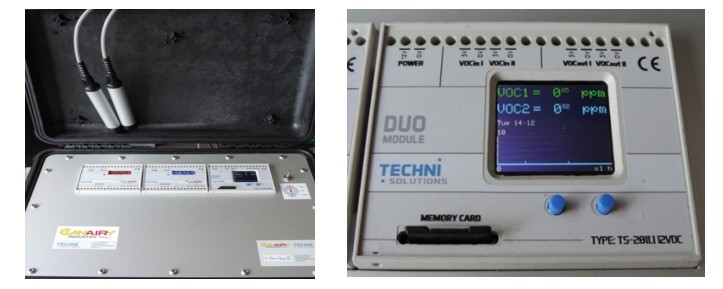
Detection probe
To determine the air quality, the measuring equipment is equipped with two detection probes. These probe’s detect a wide range of substances, including all types of VOCs, (volatile organic compounds) inorganic hydrogen compounds such as NH3 (ammonia), H2S (hydrogen sulphide) and H2, (hydrogen), as well as the partially burned carbon compounds such as carbon monoxide. Due to the broad spectrum of detection, the gas concentrations or pollution will be displayed as a total sum, expressed in ppm’s to ppt’s.
In combination with the Duo module, the detection probes can be used as a flexible detection system for a variety of gas mixtures before and after the filtering operation and can be calibrated for intervention if necessary.
Application
With the Canairy Industry Duo measuring equipment, the effectiveness of an activated carbon filter can be directly determined on site. This by measuring both connected detection probes simultaneously in front and behind the filter pack. This makes the difference between the "polluted" and "clean" air immediately clear.
The actual absorption capacity can be determined within half an hour. The built-in data logger of the Duo Module shows the graphical measurement results in ppm or Ou/m3. In addition, the output signals can be displayed online, for example, with a computer, laptop or data management system.
For gases that are not captured by activated carbon, such as ethane and methane, a three-point measurement can be performed. This is achieved by measuring part of the gas stream using an external oversized sampling filter. This way the maximum achievable absorbency can exactly be determined.
As an Example,
The graphs below show the results of a test fixture that was carried out under laboratory conditions. During this test, both the polluted air in front of the activated carbon filter and the purified air after the filter were measured.
The test was carried out with benzene vapour with a concentration of approximately 650 ppm, using approximately 7 grams of standard activated carbon. By comparing the measurement results before and after the filter, the absorption efficiency of the filter can be accurately determined. This improvement in efficiency is clearly visible in the graphs below.
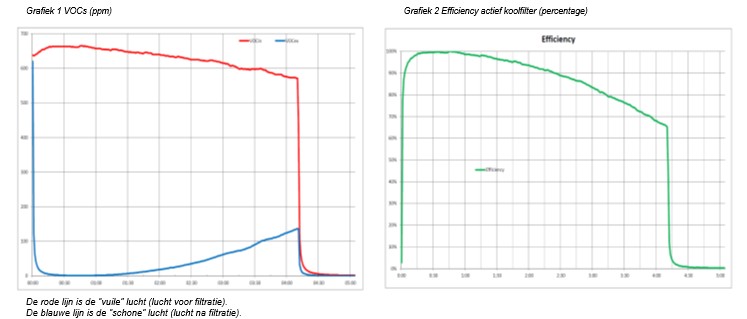
Graph 1 shows the concentration of VOC’s in front of and behind an activated carbon filter, expressed in ppm’s with comparison to the measurement period.
In graph 2, based on the measurement data from graph 1, the absorbance capacity of the filter is calculated and then illustrated. The graph shows how the absorbency of the test filter develops over the measurement period.
In addition to absolute efficiency, it also provides insight in the decline of absorption. The graph shows that the activated carbon is no longer 100% active: after about four hours the efficiency drops from 100% to about 68%. This clearly illustrates when the filter performance starts to decline.
This measuring method can be used as a check on most absorption filter technologies and provides a direct up-to-date picture of the filter status.
The detection (measurement) can be carried out in two ways.
• A measurement on location with the mobile measuring equipment measuring ones or a series of times. The report will be included.
• A continuous and daily measurement with permanently installed detection probes were the output signals of the Duo Module can be coupled with a data monitoring system. With this option, monitoring of the filter system is possible 24/7, possibly equipped with an alarm.
Techni Solutions can carry out measurements and report conclusions on location, including a report. Together with the customers, Techni Solutions always looks for acceptable solutions in occupational health and safety and environmental measures for emission control.
Should you require further explanation, we remain committed to providing you with the necessary support.